
Authenticity of Van Gogh's “Mill at Wijk” becomes even more likely
AI algorithms cannot detect fakes
- Published:
- Author: Wolfgang Reuter
- Category: Deep Dive
Table of Contents
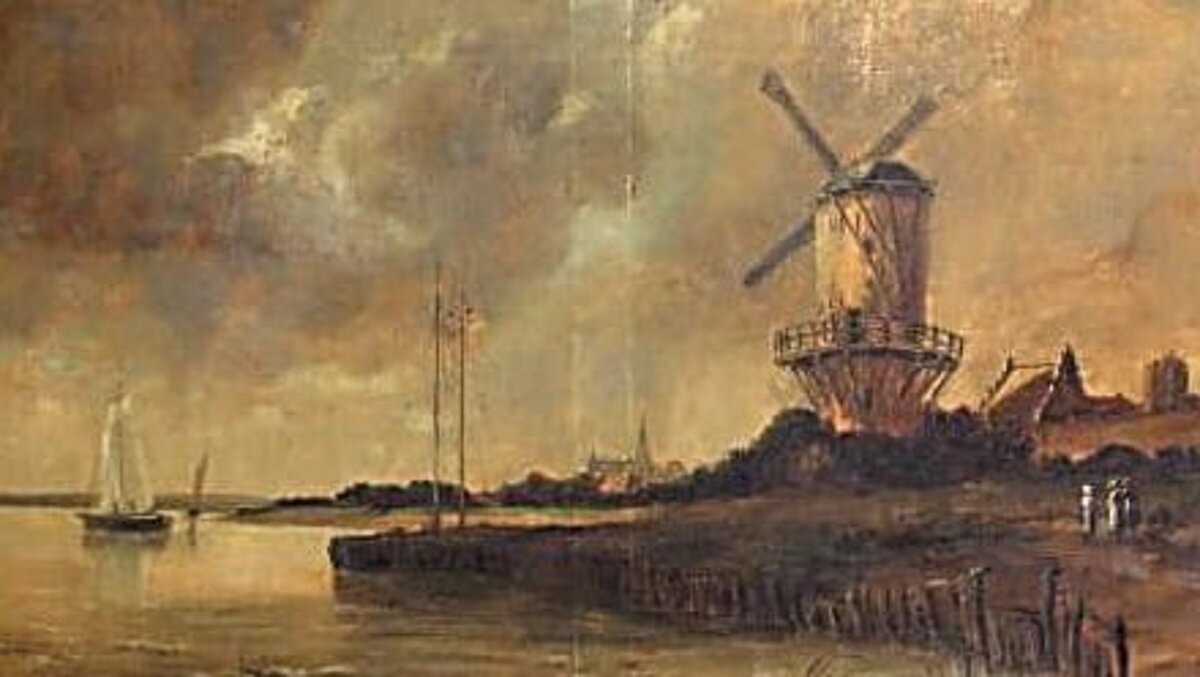
The painting “The Mill at Wijk,” which was recently discovered and attributed to Vincent van Gogh, has been verified as authentic using artificial intelligence and machine learning. The Munich-based AI and data science specialists at Alexander Thamm GmbH were unable to find any anomalies that would indicate a forgery.
The underlying neural network model recognizes a total of seven out of eight confirmed Van Gogh forgeries. These were put into circulation by art dealer Otto Wacker in the late 1920s and early 1930s. The alleged Van Gogh painting “Protestant Barn,” which appeared in Italy in 2010, is also classified as a forgery by the algorithm, as well as by numerous experts.
Classification of painting forgeries
The model developed and continuously improved since early 2017 by the company's leading data scientist, Wolfgang Reuter, is generally able to detect forgeries with a relatively high degree of accuracy. The Berlin State Criminal Police Office has been supporting the project for several years and has provided the AI expert with a total of 75 confirmed forgeries by six different artists during this time. On average, three-quarters of the forgeries are detected, although the accuracy varies from painter to painter. Of 34 Penck forgeries held by the authorities, for example, the model detects 67, but 100 percent of the alleged Max Beckmann paintings. For Heinrich Campendonk, the detection rate is 90 percent, while Max Liebermann forgeries are detected 80 percent of the time.
“However, it is important,” says Reuter, “that the method used always classifies a certain proportion of originals as positive, i.e., as suspicious or conspicuous.” On average, this proportion is 11 percent. The developer therefore states quite openly that even artificial intelligence can never provide a reliable or legally binding verdict on whether a painting is by a particular artist – or not. However, this also applies to all other methods of authenticity testing.
Human art experts and appraisers have been fooled in the past, as demonstrated by the case of Wolfgang Beltracchi, the “forger of the century” who was sentenced to six years in prison at the end of 2011. Provenance research can also only provide clues, especially if the origin of a painting has been poorly documented since its creation. Even chemical analyses are only of limited value, especially if the colors used are inconspicuous. After all, many forgers take great care not to use pigments that were commercially available at the time a painting was supposedly created. In addition, there have been cases where newer colors have been applied to a work of art during restoration. Reuter therefore sees the algorithm as a further, additional indication of authenticity, which does not render any of the conventional methods obsolete, but rather complements them.
In the case of van Gogh, the accuracy rate for detecting forgeries is 89 percent – however, just under 11 percent of the originals also tested positive (see chart below).
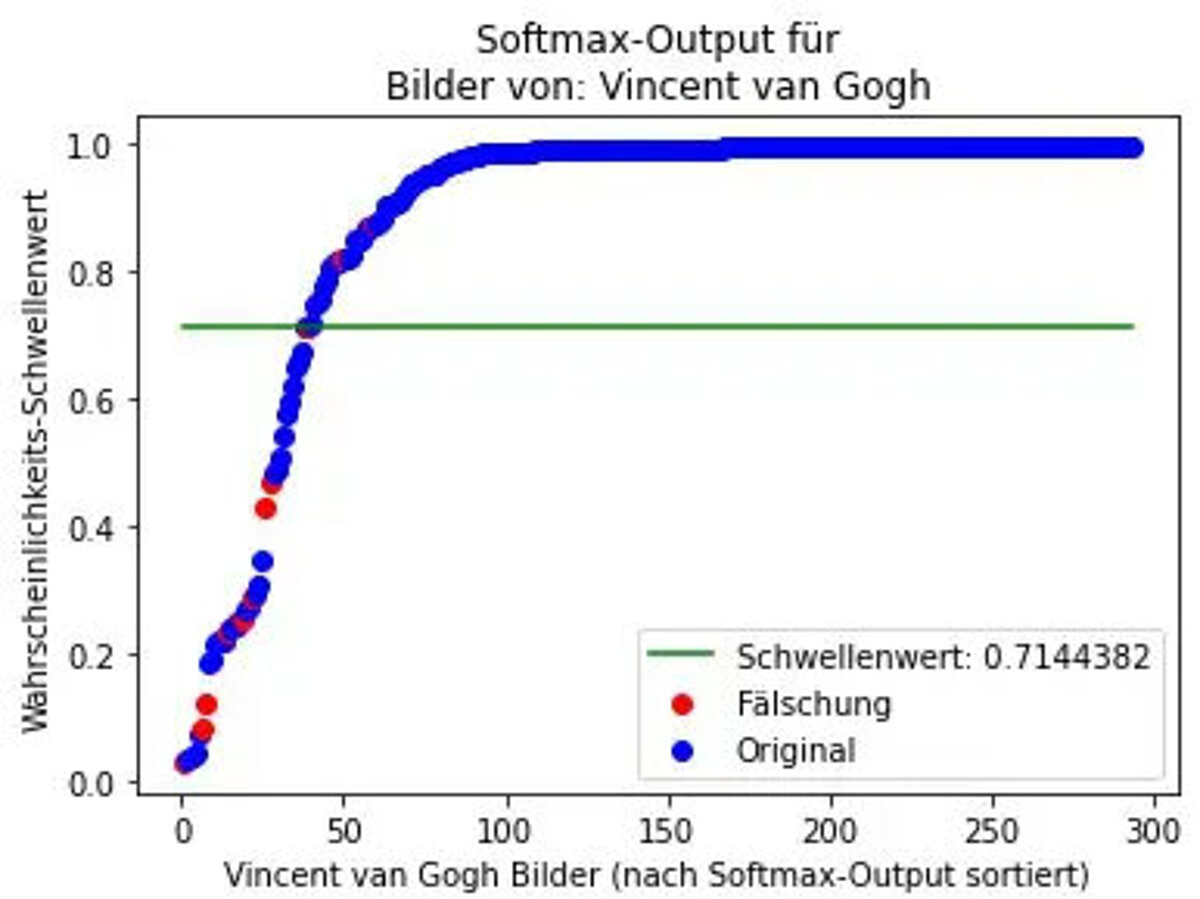
All blue dots below the green threshold value are original van Gogh paintings that would be classified as “noticeable” by the model. The red dots below the line represent recognized fakes. The slightly obscured red dot at a probability value of 0.81 represents “The Mill at Wijk,” while the dot above it, which is even more obscured, at 0.87 represents the only one of eight fakes by art collector Otto Wacker that was not recognized as such.
The Wacker forgeries were made available to Alexander Thamm by Henry Keazor, Professor of Modern and Contemporary Art History at the University of Heidelberg. They are shown below.
Images recognized as forgeries by art dealer Otto Wacker:


Image by art dealer Otto Wacker not recognized as a forgery:

“Mill of Wijk” and class activation map of the image:
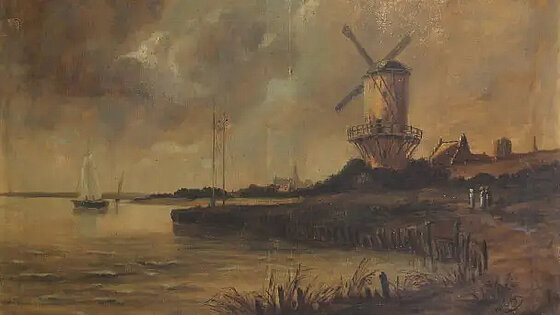

The brightly marked areas show parts of the image that convolutional neural networks have recognized as distinctly “typical of Van Gogh.” However, this should be viewed as an ex-post observation, i.e., a retrospective analysis of how the model works: The algorithm receives only 100 randomly selected and unaltered image sections measuring 224 x 224 pixels from each work of art as input. The algorithm learns for itself during training which areas or parts of the image are “characteristic” of a painter and which are not.
Neither Alexander Thamm GmbH nor Wolfgang Reuter have any contact or connection with the current owner of the painting, the auction house, or anyone else involved in the planned auction. The analysis was carried out on our own initiative and for purely scientific purposes, without any commercial interest.
If you have any questions, please feel free to contact Wolfang Reuter by phone (+49 151/ 14659820) or email (wolfgang.reuteralexanderthammcom).
Share this post: