
Back to the Future of AI – Ep. 36: Dr. Nina Stumme (DB InfraGO)
- Published:
- Author: [at] Redaktion
- Category: B2FAI
Table of Contents
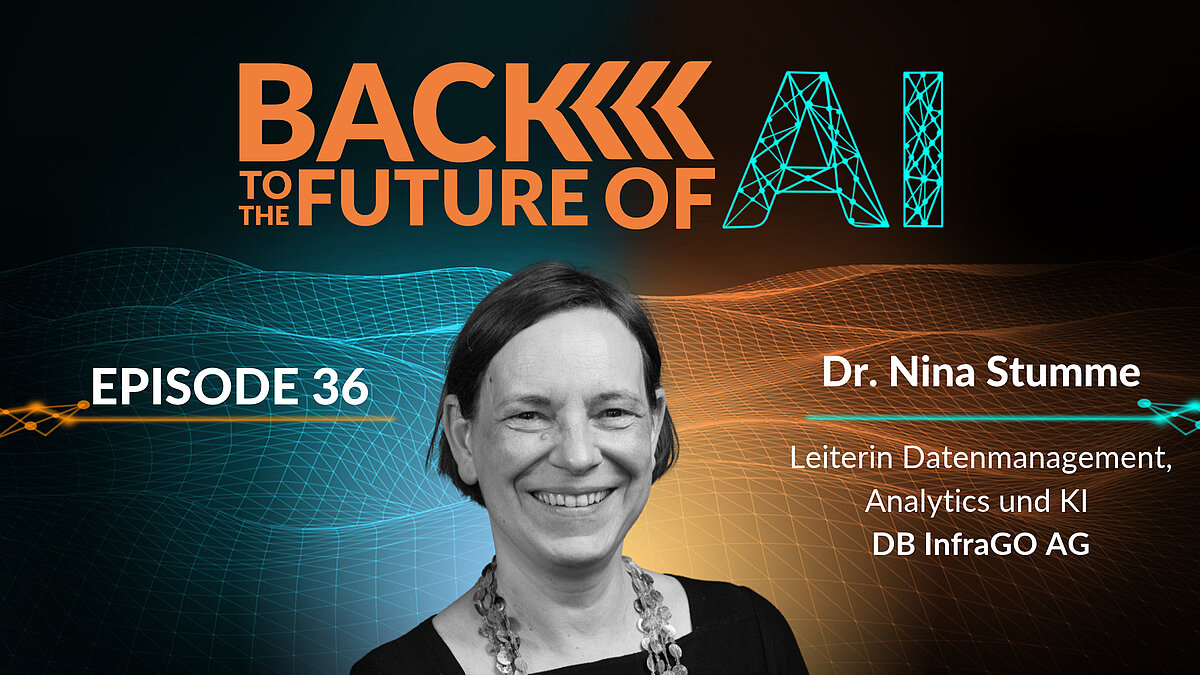
In this episode of "Back to the Future of AI," Alexander Thamm speaks with Dr. Nina Stumme, Head of Data Management, Analytics & AI at DB InfraGO.
How can 33,000 kilometres of railway track become a data-driven infrastructure? Dr. Nina Stumme of DB InfraGO joins Alexander Thamm and Dr. Christina Sievers to explore how data governance, AI agents and a digital representation of rail infrastructure – including InfraMaps – support planning, software development and maintenance. From automated reviews of construction documents to AI-assisted detection of bottlenecks and cracks in concrete sleepers, the episode shows why AI at scale depends on high-quality data, practical governance and people who embrace change.
Back to the Future of AI | Ep. 36 | Dr. Nina Stumme
What do reliable data and on-time trains have to do with each other, and how does AI contribute? In Episode 36 of “Back to the Future of AI,” Alexander Tamm and Dr. Christina Sievers speak with Dr. Nina Stumme about one of Germany’s most exciting digitalization projects. In this episode, Nina shows how data and AI are helping the 70,000 employees at DB InfraGO make Germany’s rail infrastructure more efficient—and thereby lay the groundwork for a more reliable rail system.
Nina takes us through the foundations for AI that have been laid in recent years with data governance and the DataNet data and AI ecosystem, and explains which value-added applications have already been developed for employees—such as a standardized construction project management system.
Now comes the next step: agentic AI and a digital twin of the rail infrastructure.
With the AI Office, DB InfraGO combines the development of concrete applications, AI governance, and employee empowerment. In IT, agent-based development environments, team-oriented knowledge bases, and common standards for the entire software lifecycle are being established. This is intended to make AI systematically scalable beyond individual use cases. LINK
With the Digital Infrastructure Representation, DB InfraGO is building an intelligent model of the physical rail infrastructure as the foundation for planning, maintenance, and operations. With the initial rollout of solutions such as InfraMaps and the increasing use of image and sensor data, the condition of the infrastructure is set to become even more transparent and automatically assessable in the future. LINK
This episode demonstrates that the sustainable use of AI depends not only on models, but also on reliable data, practical governance, a clear strategy, and strong teams. After all, it is the employees who understand the context and significance of the data. Recognizing data as an asset lays the foundation for this and turns data into an effective lever for a more reliable rail system.
Listen in when it’s ‘Back to the Future of AI’ again!
Spoken language: German
Listen to and subscribe to the latest episode now on Apple Podcasts, Spotify, Google Podcasts and Deezer:
Share this post: